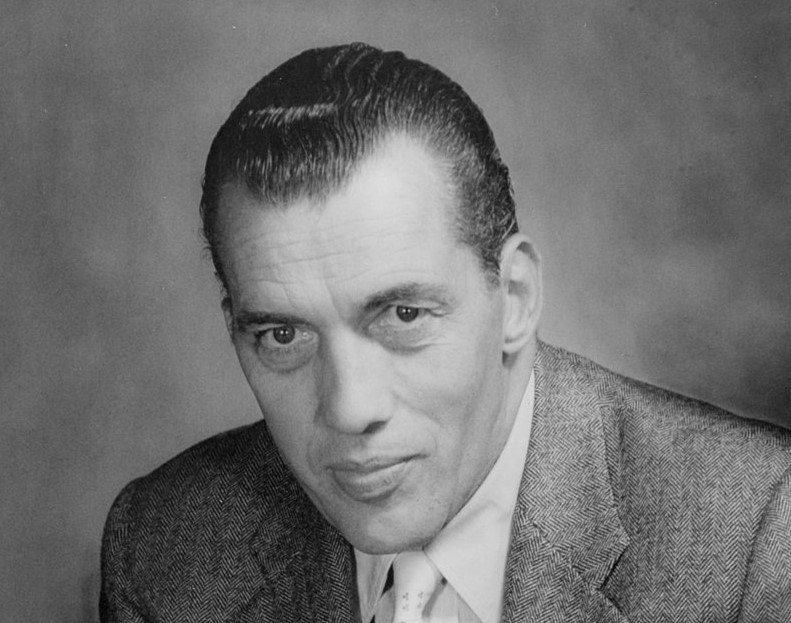
“Sunday Best- The Untold Story of Ed Sullivan”- A Cultural Masterpiece
Entertainment, Film Reviews — By Buddy Sampson on August 7, 2025 at 1:30 pm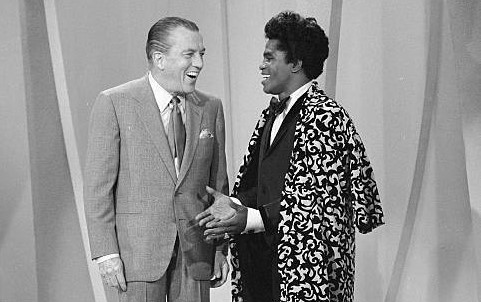
Cover Photo: Ed Sullivan. Inside photo-Ed Sullivan and James Brown. Photos- Getty Images.
By Buddy Sampson
Black music is American music. However, American history is being revised, right before our eyes. Black history, despite those that try to deny it, or sweep it under the rug, is ingrained in the fabric of America and undoubtably has had an impact on all sectors of culture, especially in music. There are silent heroes, those that quietly chipped away at racism, unlikely heroes that have made Black music acceptable in all homes, even when it was dangerous to do so.
Ed Sullivan was one of those heroes. His untold story- the behind-the-scenes story- is captured in the Netflix documentary “Sunday Best- The Untold Story of Ed Sullivan.” The film is a cultural masterpiece and should not only be viewed by Black Americans, but all Americans, to completely understand the evolution of Black music.
A Delirio Films Production, the film had several producers, including Ed Sullivan’s granddaughter, Margo Precht Speciale. The film also had several Executive Producers, including Andrew Solt, Josh Solt, Zoe Morrison and Kerry Gordy, one of Berry Gordy’s eldest sons.
Gordy was approached with the idea of Executive producing the documentary after working with director Sacha Jenkins on two previous films, “Bitchin: The Sound and Fury of Rick James” and “All Up In The Biz.” “When he came to me about Ed Sullivan, I said, cool,” said Kerry Gordy. “But we have to do it from a different perspective. And he was like, I already know.”
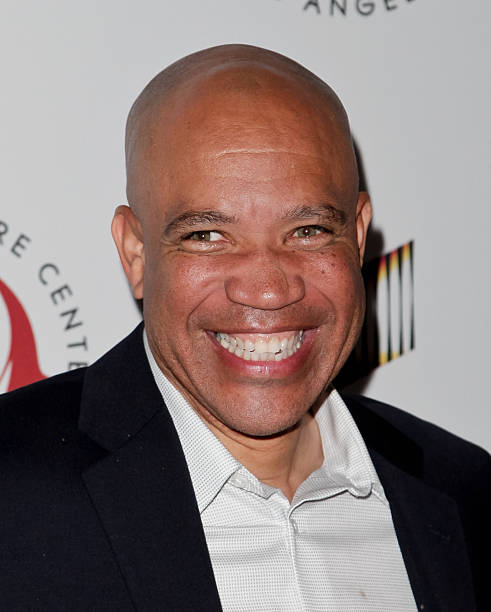
Kerry Gordy- Photo- Tibrina Hobson. Getty Images.
Ed Sullivan’s granddaughter, Margo, was very excited about the idea. “She was all excited about doing it from a Black perspective as opposed to doing it from the normal Beatles and Elvis perspective,” he said. “And the reviews have been over the top. It’s been amazing.”
Indeed, for many Black families, The Ed Sullivan Show was a family tradition on Sundays. Families would gather around their consoles and families that did not have televisions would visit other families, just to see the show, which often had performers of color, rare in the early days of television.
“That was the only place that Black people could go to see people that looked like them on television during those times,” Gordy explained. “So, without Ed Sullivan, you wouldn’t have been able to see Sammy Davis jr., Louie Armstrong, Lena Horne, Nat King Cole and of course all the Motown acts, The Supremes, The Temptations, The Jackson Five- it was a place that I could go and know I could see someone that looked like me on television, because other than that, television was completely whitewashed.”
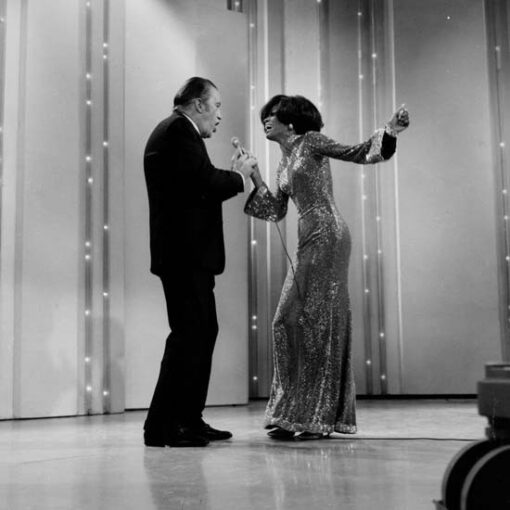
Ed Sullivan with Diana Ross. She managed to get Ed Sullivan to sing.
Kerry Gordy outlined problems with the censors, who didn’t take too kindly to any contact on television between members of different races. “He (Ed Sullivan) didn’t just put them on, he shook their hands, he put his arms around them, and Diana Ross even kissed him,” he laughed. “That was unheard of at that time. The sponsors were going crazy, the broadcasters were going crazy, the Ku Klux Klan and the Jim Crow South were up in arms. It was horrible. People didn’t know what Ed Sullivan had to go through.”
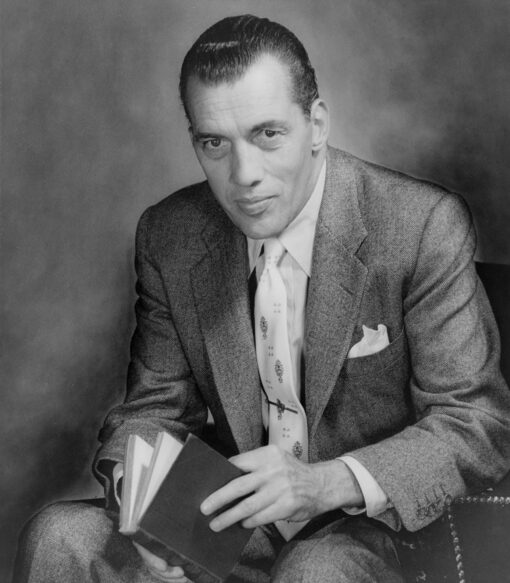
Ed Sullivan.
Edward Vincent Sullivan was born in 1901 in Harlem, New York. Growing up in Harlem, he had a sensibility that many didn’t have in his community. “He was not prejudiced,” said Gordy. “He was brought up as an Irish immigrant with his father and when the Irish came to this country, they were the ones looked at as lazy, drunkards and stupid, and his father despised that.”
Sullivan’s family made friends and connections with Black families, and didn’t buy into the stereotypical images of Black people. “They realized that they were people, then when he saw their talent, he said ‘this has to be seen,” he explained “And in fact we had incredible talent. There was a preponderance of Black talent that was excellent.’”
When asked about how they compiled the footage, Kerry Gordy was very candid. “That was the hard part,” said Kerry, “because there was so much incredible footage and we had to tell a story and we had 90 minutes to do it. A lot of people, unfortunately, were left out.”
A touching moment in the film focused on Harry Belafonte’s appearance on the Ed Sullivan show. The brass at CBS and many of its affiliates didn’t want Belafonte, an activist and civil rights advocate to appear on the show. However, after a visit to Ed Sullivan’s hotel by Belafonte, Sullivan had his mind made up. Despite the danger of the show being canceled, he dared to have Belafonte on the program. “His granddaughter, Margo was a champion of this thing and she found a whole bunch of his letters and writings,” explained Kerry, “and was able to piece it all together. That was his voice we used, with an AI, and everything he said was his exact words. We did not put any words into his mouth. So, it’s his voice and his words. You get the okay from the estate, and you want to make it sound authentic.” Kerry, who owns a voice generating AI company, does however realize the dangers of AI. “AI can be good or bad,” he said. “We decided to use it in a good way.”
Margo Speciale came up with the idea of the documentary on her grandfather, however, things took a sharp turn when she heard from an iconic family. “She had a meeting with these two ladies,” said Kerry. “And these two were saying ‘oh my gosh,’ your grandfather was a major factor in our household. And he was really really important to Black people. Come to find out, she was Ambassador Shabazz, Malcolm X’s daughter. They treated her like she was a star and that’s how the initial concept came up.”
Six Degrees of Separation
“He’s a hero,” said Kerry Gordy. “Ed Sullivan puts people on his show and popularizes them. And my father (Berry Gordy) was thinking ‘if I could get some of my talent on the Ed Sullivan show, that would be great.’ Then he gets Stevie Wonder in the show. Once he gets Stevie on the show, then Ed knows who Motown is, and later on, he gets Michael Jackson and the Jackson Five on the show. Quincy Jones and Michael Jackson make one of the biggest albums of all time, ‘Thriller’ which attracted Stephen Spielberg, who cast a budding star who had a television show, Oprah Winfrey. Oprah ends up endorsing Barack Obama, so without Ed Sullivan there would not have likely been a Barack Obama.”
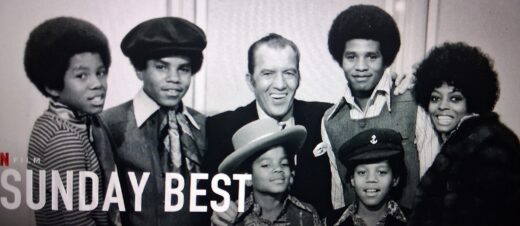
“Sunday Best, The Untold Story of Ed Sullivan,” is on Netflix, streaming now.
Ed Sullivan’s roots in Harlem were integral for the success of the iconic series. “He knew them, he knew Black people,” said Kerry Gordy, “And he knew that Black people were hard working, and that they were good people, he knew they were getting a ridiculous rap and he sympathized. Because remember when they came to the country, they were the low man on the totem pole for no good reason. And he thought Black people were given a hard time for no good reason. His principles would not let him treat another human being, unequal, because he believed the content of one’s character is way more important.”
“Sunday’s Best, The Untold Story of Ed Sullivan” is a historical, but emotional documentary film that will bring thought, conversation and inspiration for those that choose to watch this incredible piece of work. It is simply a cultural masterpiece. It is now playing on Netflix and it is a must see for everyone, but especially the Black community.
 Tweet This
 Digg This
 Save to delicious
 Stumble it
 RSS Feed