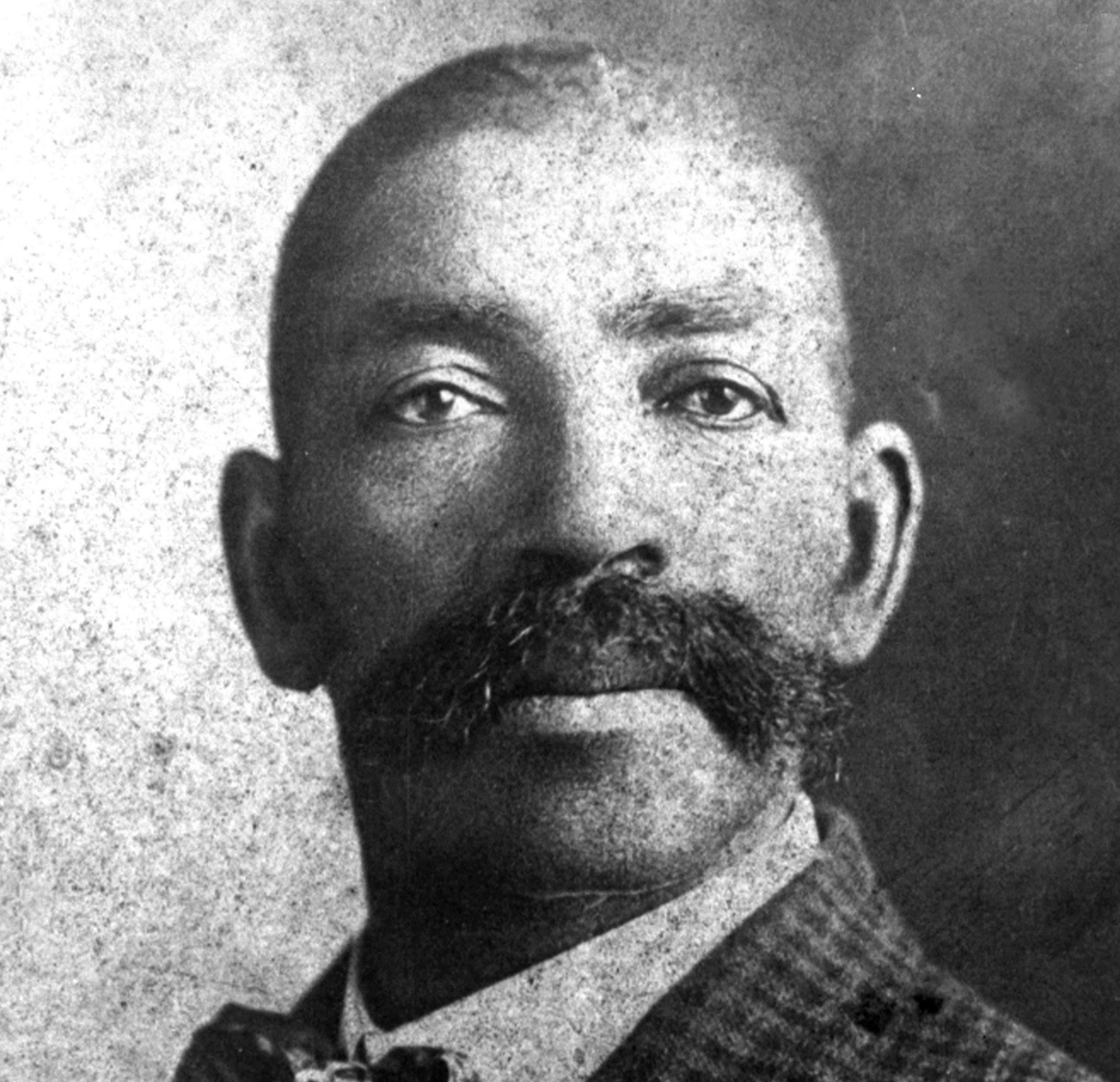
Bass Reeves- A Great American Hero
History, News — By Buddy Sampson on August 26, 2025 at 5:00 pm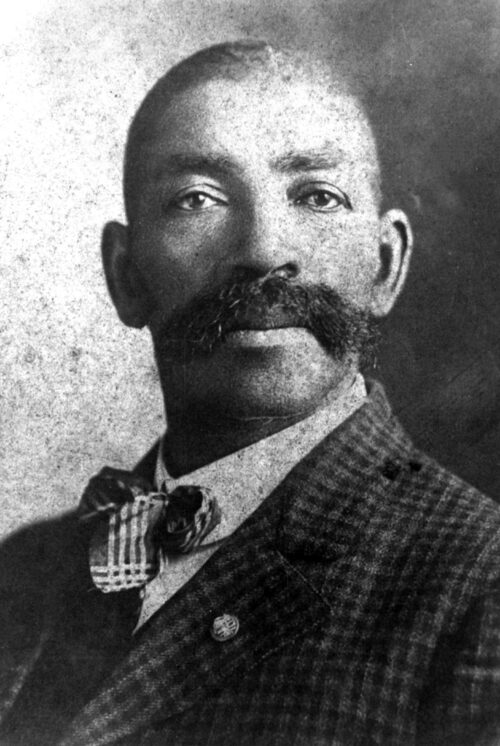
Cover and Inside Photo: Bass Reeves.
By Buddy Sampson
Black History is American History. Period. Unfortunately, there are those in our current system of government that are determined to erase our history, erase our achievements, and even imitate our style of dress, our mannerisms and even appropriating our history as their own.
The Scoop LA, as formerly The Scoop Newspaper, has always devoted sections of the newspaper to Black Historical figures. We plan on publishing a piece on Black Historical Figures every Tuesday.
Our first piece is on Bass Reeves, an American lawman and one of the first Black deputy U.S. Marshals in the American West, according to Brittanica.com. Born in 1838, in Crawford County, Arkansas, Reeves died in Muskogee, Oklahoma in 1910.
According to the Oklahoma Historical Society, Bass Reeves was “born as a slave in Arkansas, grew up in Lamar and Grayson counties, Texas, where he belonged to Col. George R. Reeves, later to become the speaker of the house in the Texas legislature.” He escaped north into the Indian Territory, and he became acquainted with the Cherokee, Creek, and Seminole. It is believed he served as a soldier with the Union Indian Home Guard Regiments during the Civil War. After the war Reeves settled down in Van Buren, Arkansas, as a farmer. On occasion he would serve as a guide for deputy U.S. marshals who worked out of the federal court at Fort Smith, Arkansas, into the Indian Territory. In Kareem Abdul Jabber’s book, “Black Profiles In Courage,” he mentions that term “cowboy” was a derogatory term used for African- Americans that handled cattle and farming chores. Cow-boy is what Black men were called, while White cattle ranchers and farmers were called cattlemen (cattle-men). Over years, the term cowboy, of course, was appropriated by White culture, even as it was originally meant to be a very derogatory terminology for Black cattle hands. Reeves “knew Indian Territory” and “as a result of his skills and his knowledge of the territory, he was able to make substantial money as a scout and tracker for peace officers. In 1875, when Judge Isaac C. Parker took over the Fort Smith federal court, Parker commissioned Reeves as a deputy U.S. Marshal. He is believed to be one of the earliest African Americans to receive a commission as a deputy U.S. Marshal west of the Mississippi River.”
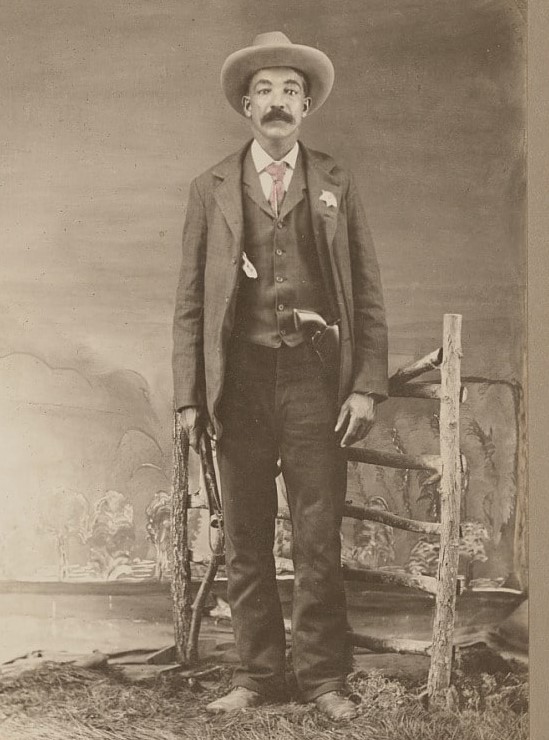
Bass Reeves. Photo- Collection of the Smithsonian National Museum of African American History and Culture.
In several sources we’ve uncovered, some say that the character, “The Lone Ranger,” was based on the exploits of this amazing Black man of American History. Reeves was one of the unsung heroes of the West, and recently, some studios, such as Paramount Plus, have had television series devoted to Black lawmen, such as “Lawmen: Bass Reeves,” based on the legendary aspects of this great American hero. Although some newspaper accounts have reported that he killed 14 outlaws- those accused of rape, murder and other heinous crimes, there is likely no historical records that indicate the true numbers of the outlaws he killed. One newspaper, The Chickasaw Enterprise, reported, in 1901 that Reeves arrested more than 3000 men for violating federal laws in that region, mostly working alone. In the newspapers at the time, it was reported that he brought in a wide assortment of colorful criminals, Black, White, Indian, male and female. Fees were paid to him, and he made thousands of dollars for his captures.
Bass Reeves was a clever deputy U.S. Marshal and used disguises and ruses to get his man or lady. He once pretended to be a robber to capture two outlaw robbers. His intelligence put him head and shoulders over other marshals, and he was known as an incredibly accurate shot, banned from local contests because of his unmatched skill with a gun or rifle. Upon retirement in 1907, he became a city police officer in Muskogee, Oklahoma, where he died January 12, 1910.
When stories are told about the West, many of the portrayals of some of the most historic figures that lived have often been whitewashed in history. Sure, there are many true White American heroes. However Black American heroes are prevalent in the formation and creation of many of the territories and settlements of the U.S. and should be lauded for great achievement in celebrating the prosperity of America.
Sources:
Abjul-Jabbar, Kareem; Steinberg, Alan “Black Profiles In Courage,” William Morrow & Co. Inc.
Burton, Art T. “Bass Reeves,” The Encyclopedia of Oklahoma History and Culture, https://www.okhistory.org/publications/enc/entry?entry=RE020.
Editors, Encyclopaedia Britannica, “Bass Reeves” https://www.britannica.com/biography/Bass-Reeves.
Tags: African, American History, Black American History, Black History, History, TheScoopLA_thelascoop
 Tweet This
 Digg This
 Save to delicious
 Stumble it
 RSS Feed